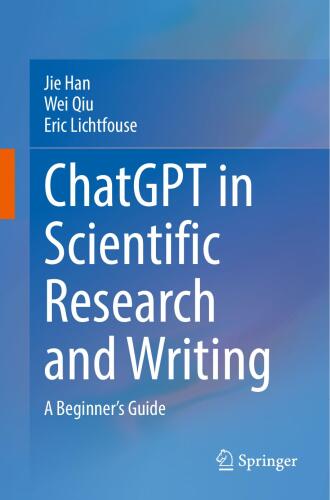
ChatGPT in Scientific Research and Writing: A Beginner’s Guide
Eric Lichtfouse, Jie Han, Wei Qiu
Description
Discover How ChatGPT Can Transform Scientific Research and Academic Writing
Scientific research and academic writing require careful planning, critical thinking, reliable sources, and clear communication. ChatGPT in Scientific Research and Writing introduces readers to the potential of artificial intelligence in supporting the research and writing process. It is a useful resource for students, researchers, teachers, scholars, and academic professionals who want to explore how ChatGPT can assist with their academic work.
From developing research ideas to refining written content, ChatGPT can support various stages of the research journey. Understanding how to use it effectively can help researchers organize their thoughts, explore complex topics, improve writing clarity, and work more efficiently.
What Will You Learn from This Book?
By reading ChatGPT in Scientific Research and Writing, you can explore how to:
- Generate research ideas: Use ChatGPT to brainstorm potential research topics and identify questions worth investigating.
- Develop research questions: Organize ideas into focused, meaningful research questions and objectives.
- Support literature reviews: Summarize supplied texts, organize themes, and identify areas that may require further investigation.
- Improve academic writing: Enhance grammar, readability, sentence structure, and the overall clarity of scientific documents.
- Structure research papers: Understand how AI can assist with planning introductions, methodology sections, discussions, and conclusions.
- Create effective prompts: Learn to communicate your research needs clearly to obtain more relevant and useful AI-generated responses.
- Save time during research: Explore ways to streamline brainstorming, outlining, editing, and other repetitive writing tasks.
- Maintain research integrity: Understand the importance of verifying AI-generated information, protecting confidential data, acknowledging AI assistance when required, and following academic policies.
Why Should You Read This Book?
Artificial intelligence is changing how people approach research, information discovery, and academic communication. Learning to use ChatGPT responsibly can help you adapt to these developments and build valuable digital research skills.
This book is worth exploring if you want to understand how AI can complement traditional research methods. It can help you discover practical ways to organize ideas, improve your writing process, and approach academic tasks with greater confidence.
Rather than replacing the researcher's expertise, ChatGPT should be used as an assistant that supports human judgment, originality, and critical analysis. Scientific claims, references, statistics, and AI-generated explanations must always be checked against reliable sources.
Who Should Read This Book?
This book may be useful for:
- University and college students working on assignments, dissertations, and theses.
- Scientific researchers preparing manuscripts, research proposals, and literature reviews.
- Teachers, lecturers, and academic professionals interested in AI-assisted writing.
- Postgraduate scholars looking to improve research productivity.
- Academic writers who want to explore AI-assisted editing and idea development.
- Beginners who want to understand the role of ChatGPT in scientific research.
Enhance Your Research Skills in the Age of AI
Whether you are beginning your first research project or looking for ways to improve your academic writing workflow, ChatGPT in Scientific Research and Writing offers an opportunity to explore the practical applications of conversational AI in academia. Discover how to combine AI assistance with reliable evidence, independent thinking, and responsible research practices to produce clearer and more organized academic work.
Explore the possibilities of ChatGPT and take a more informed approach to scientific research and writing.
Language
English
Publisher
Springer
Year Published
2024
Categories
Artificial Intelligence (AI), Computer Science